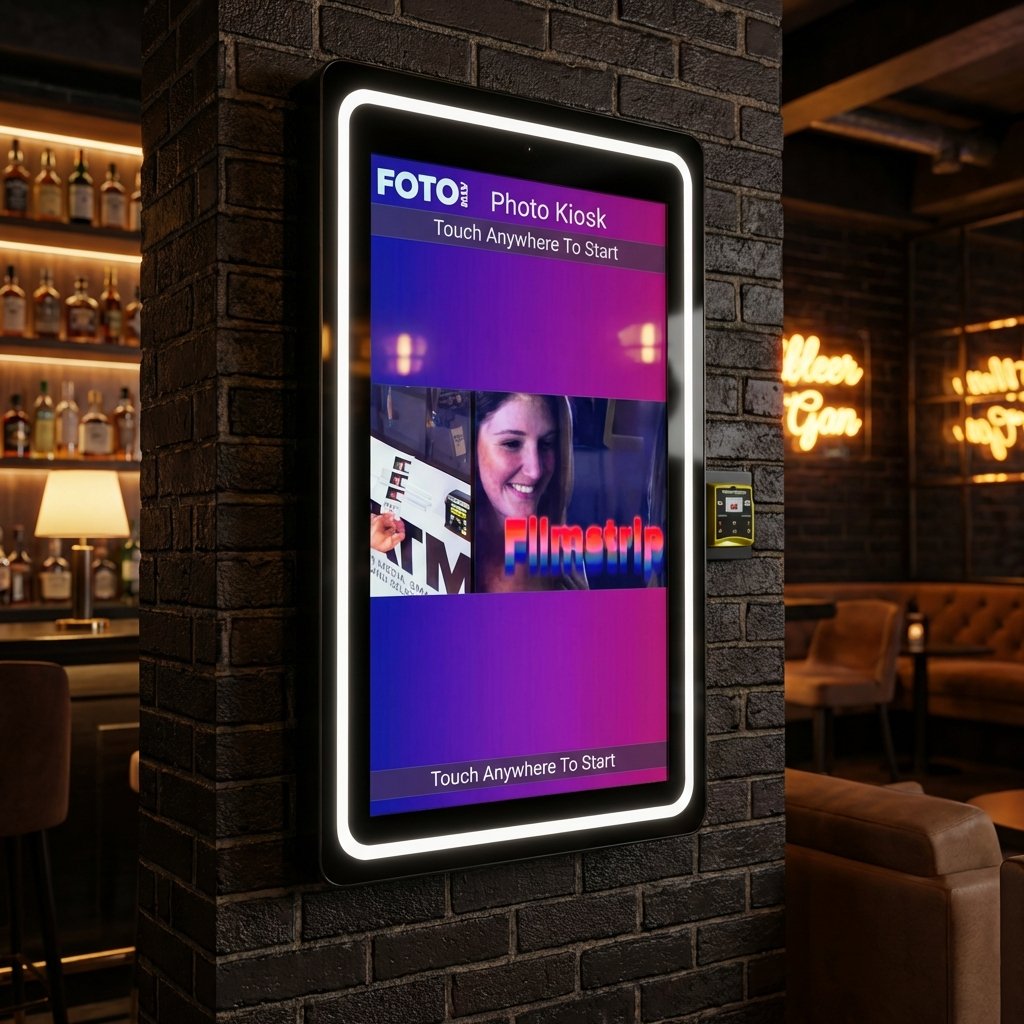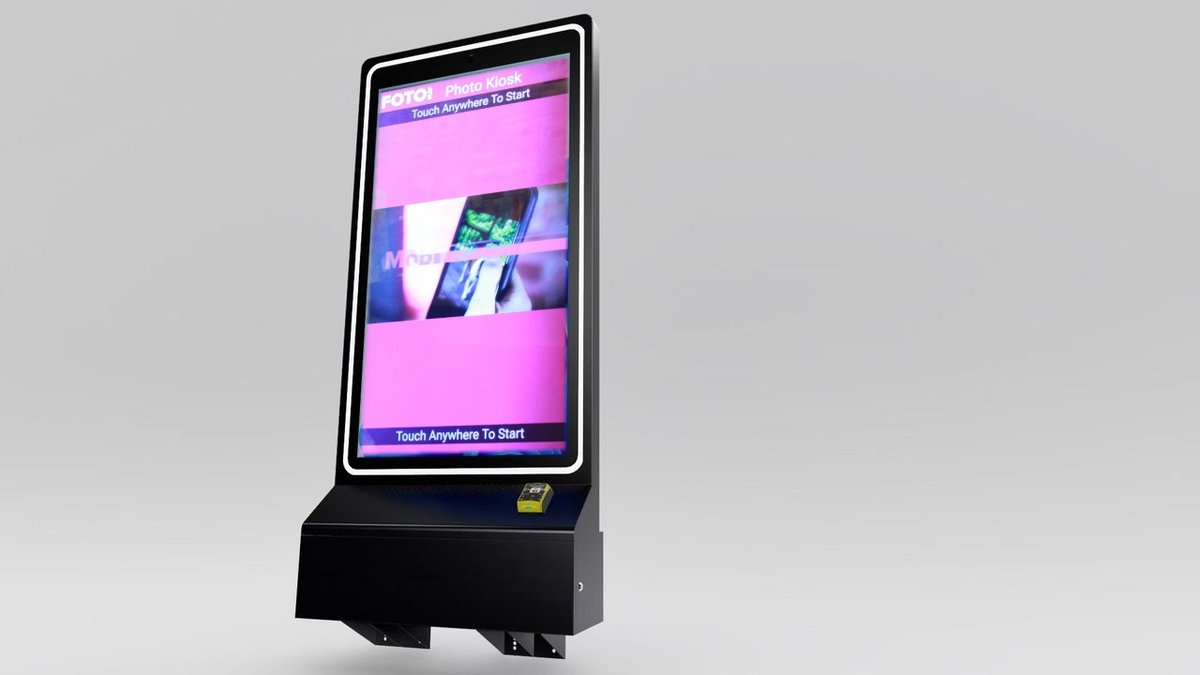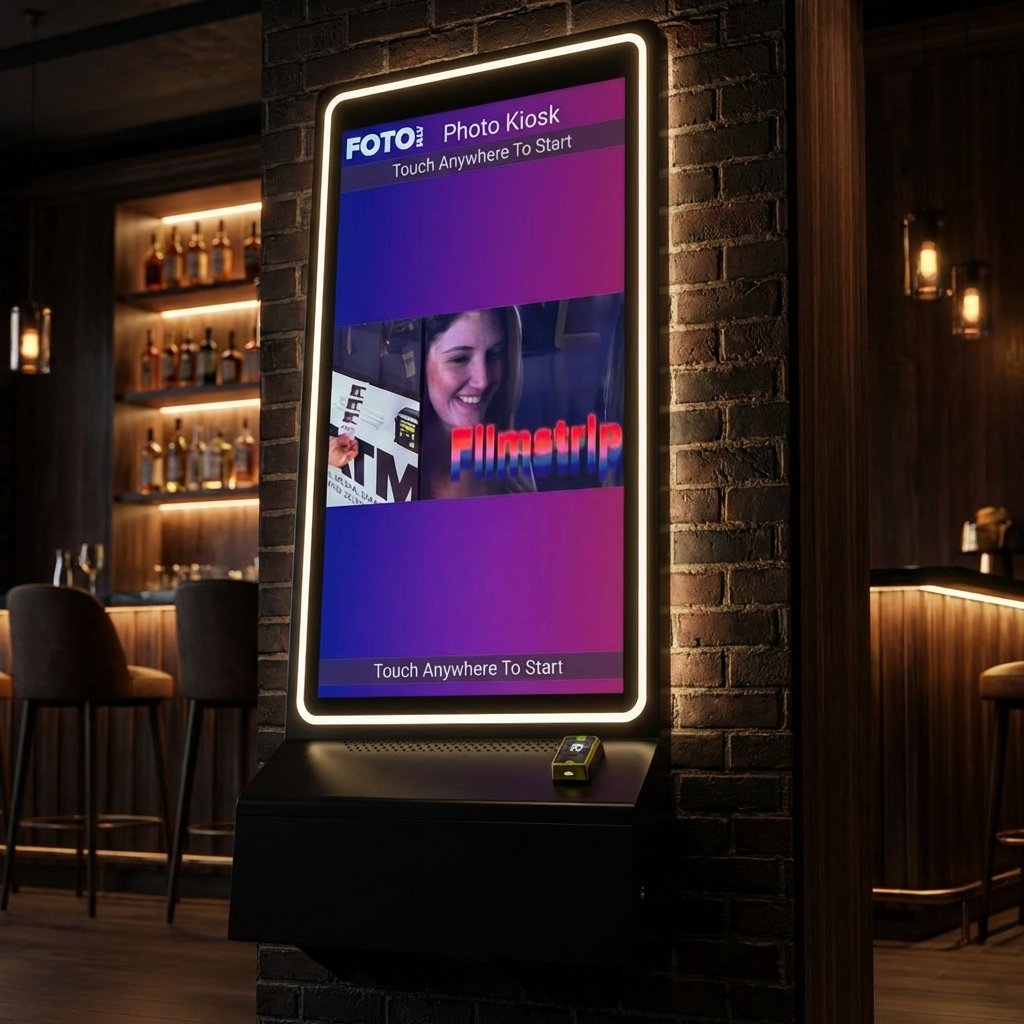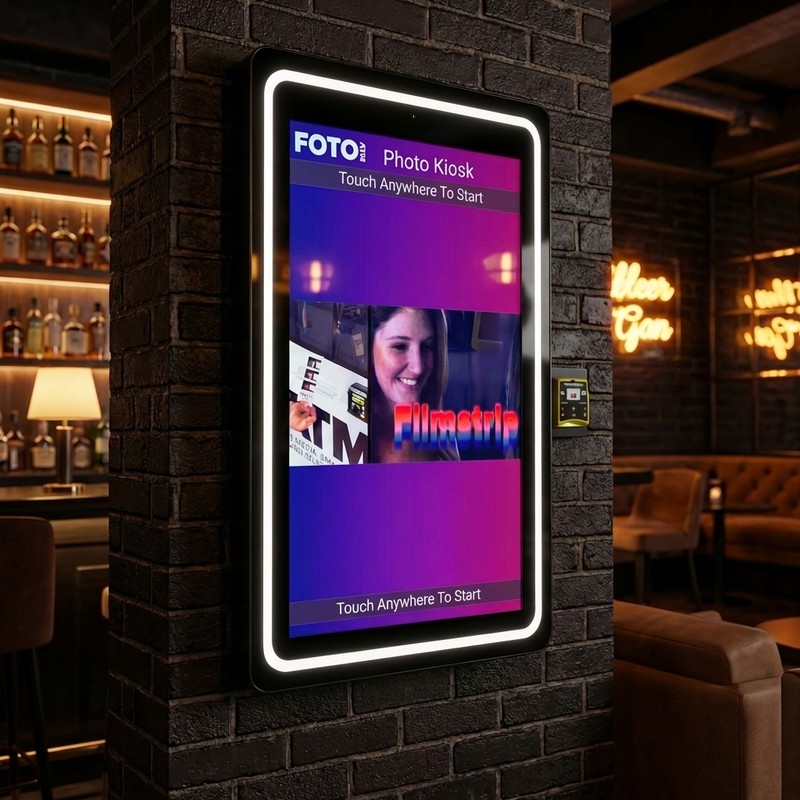
If you’re a venue owner searching for a wall-mounted photo booth, two names keep coming up: FotoATM and Simple Booth HALO. Both mount to a wall. Both take photos. But that’s roughly where the similarities end.
This is a fair, detailed breakdown of both products so you can decide which one actually fits your business. If you run a bar, restaurant, or entertainment venue and want passive revenue with zero babysitting, pay close attention to the differences.
Quick Comparison
| Feature | FotoATM Velo | Simple Booth HALO |
|---|---|---|
| Starting Price | $4,999 (27”) / $7,999 (49”) | $1,490 (mount kit only, no iPad) |
| Type | All-in-one kiosk (screen, printer, payment) | iPad mount + software subscription |
| Built-in Printer | Yes (dye-sub, instant prints) | No |
| Payment Terminal | Yes (EMV tap/chip/swipe) | No |
| Fully Unattended | Yes | Partial (no monetization without staff) |
| Wall-Mounted | Yes | Yes |
| AI Green Screen | Yes | No |
| Software Cost | Included | $9-$34/week ($468-$1,768/year) |
| Target User | Venue owners seeking passive revenue | Event marketers and brand activations |
Where Simple Booth HALO Shines
Credit where it’s due. Simple Booth built a strong product for its intended use case:
Data capture and marketing integration. HALO is excellent at collecting emails, phone numbers, and social handles during branded activations. If your primary goal is lead generation at a trade show booth or corporate event, HALO’s software integrations with CRMs and marketing platforms are genuinely impressive.
Lower upfront cost. At $1,490 for the mount kit (iPad not included), the barrier to entry is low. For event companies running occasional branded activations where someone is always on-site, this price point makes sense.
Clean, minimal design. The HALO mount is sleek. It looks good on a wall at a product launch or pop-up experience where aesthetics matter and functionality is secondary to brand presentation.
Strong sharing features. HALO’s software handles SMS and email delivery well, and their gallery/sharing experience is polished. For events where the goal is social amplification, this works.
Where FotoATM Wins
For venue owners — the people who need a photo booth that makes money on its own, every single day — FotoATM addresses the gaps that HALO doesn’t:
Built-in printer. This is the big one. HALO has no printer. Guests can only share photos digitally. FotoATM’s integrated dye-sub printer produces physical prints in seconds. Physical prints are what guests pay for. No printer means no direct revenue from the kiosk itself.
Integrated EMV payment terminal. FotoATM has a built-in card reader that accepts tap, chip, and swipe payments. Guests pay $3-$5 per print session. HALO has no payment processing at all — there’s no mechanism for a guest to pay to use it.
True unattended operation. FotoATM is designed to run 24/7 without anyone touching it. The cloud dashboard lets you monitor status, track revenue, and manage settings remotely. HALO requires someone to set up the experience, monitor the iPad, and ensure it doesn’t walk off the wall (it’s an iPad, after all).
Revenue generation vs. cost center. This is the fundamental difference. FotoATM is a revenue-generating asset. Venues report $500-$1,500/month in passive income. HALO is a marketing tool — it costs money to operate (hardware + $9-$34/week software subscription) and generates value indirectly through data capture.
Key Differences Breakdown
1. The Revenue Model Problem
Simple Booth HALO is built for brand activations where a company pays for the experience. The booth itself doesn’t generate revenue from end users. There’s no printer, no payment terminal, no way for a guest to swipe a card and walk away with a print.
FotoATM flips this model. The kiosk pays for itself. At $3-$5 per session with an average of 10-30 sessions per night in a busy bar, you’re looking at $30-$150 per night in passive revenue. Over a month, that’s $500-$1,500 depending on foot traffic. The Velo typically pays for itself within 2-6 months.
2. Total Cost of Ownership
HALO looks cheaper at $1,490, but let’s do the real math:
- HALO mount kit: $1,490
- iPad (not included): $449-$1,099
- Weekly software subscription: $468-$1,768/year
- Year 1 total: $2,407-$4,357 (with no printer, no payment terminal, no revenue capability)
FotoATM Velo 27”:
- Complete kiosk with printer, payment terminal, screen: $4,999
- Software: included
- Year 1 total: $4,999 (revenue-generating from day one)
By year two, HALO’s ongoing software costs push the gap even closer while still producing zero direct revenue. FotoATM’s year-two cost is consumables only (paper and ink), which are covered many times over by guest payments.
3. Durability and Security
An iPad mounted on a wall in a bar is a liability. Drinks get spilled. People get rowdy. iPads get stolen. HALO is designed for supervised, controlled environments — not the reality of a Friday night at a sports bar.
FotoATM’s Velo is a commercial-grade steel enclosure with a bonded touchscreen. It’s built for the same environments as ATMs and arcade machines. The payment terminal and printer are enclosed and secured. There’s nothing to steal and nothing fragile exposed to the crowd.
4. AI Green Screen
FotoATM includes AI-powered green screen technology that automatically removes backgrounds and places guests in custom scenes — tropical beaches, cityscapes, branded environments. This is a massive engagement driver that keeps guests coming back and paying for prints.
HALO relies on the iPad camera with no background replacement capability built in.
5. The “As Seen on Bar Rescue” Factor
FotoATM has been featured on Bar Rescue, the hit show focused on turning struggling bars into profitable venues. That’s not a coincidence — FotoATM was built specifically for the bar and restaurant industry. Every feature, from the commercial enclosure to the payment terminal to the cloud management dashboard, was designed for venue owners.
HALO was built for event marketers. Different product for a different customer.
Who Should Choose What
Choose Simple Booth HALO if:
- You run branded events or activations with staff on-site
- Your goal is data capture and lead generation, not direct revenue
- You have a controlled environment (corporate offices, trade shows)
- You want the cheapest possible wall-mounted photo experience
- You don’t need prints or payment processing
Choose FotoATM if:
- You own a bar, restaurant, arcade, or entertainment venue
- You want passive revenue from day one with no staff required
- You need a commercial-grade kiosk that survives a bar environment
- You want built-in printing and payment processing
- You want to monitor everything remotely via cloud dashboard
The Bottom Line
Simple Booth HALO is a solid marketing tool for supervised brand activations. FotoATM is a revenue-generating kiosk built for the reality of running a venue. They’re fundamentally different products solving different problems.
If you’re a venue owner looking for a Simple Booth alternative that actually puts money back in your pocket, FotoATM is purpose-built for you.
Ready to see how FotoATM stacks up for your specific venue?
- Take the 2-minute quiz to find your ideal kiosk
- Compare all FotoATM models side by side
- Talk to our team about your venue